 1 month ago
41
1 month ago
41
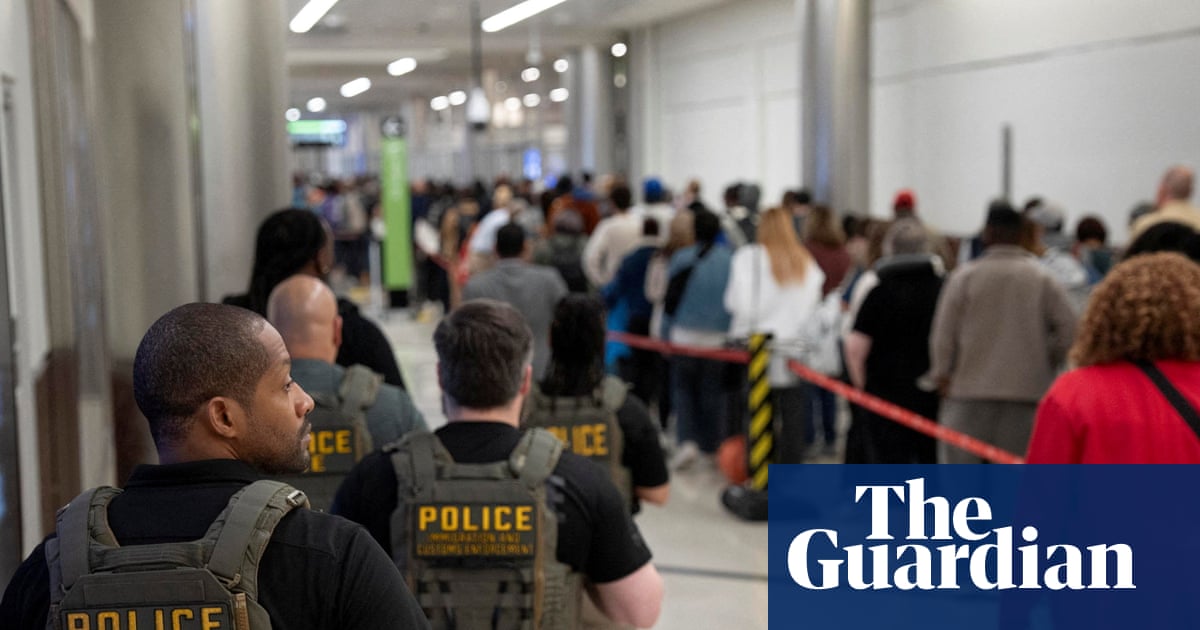
A federal judge has temporarily restricted immigration officers from shooting teargas or projectile munitions at protesters outside the Immigration and Customs Enforcement building in Portland, Oregon, which has been the site of repeated demonstrations since last year that the Trump administration has increasingly met with force.
The US district judge Michael Simon’s ruling comes after a weekend in which immigration agents at the ICE building fired teargas, pepper balls and rubber bullets into a crowd of thousands of protesters that included children. Local officials had described the protest as peaceful prior to the excessive force.
“Defendants’ violence is in no way isolated,” the order reads, adding that “the culture of the agency and its employees is to celebrate violent responses over fair and diplomatic ones”.
The order bars federal officers from using chemical or projectile munitions unless the person targeted poses an imminent threat of physical harm. Simon also limited federal officers from firing munitions at the head, neck or torso “unless the officer is legally justified in using deadly force against that person”.
The temporary restraining order will be in effect for 14 days.
The ruling came in response to a lawsuit filed by the American Civil Liberties Union of Oregon on behalf of protesters and freelance journalists covering demonstrations at the flashpoint ICE building.
The suit names as defendants the Department of Homeland Security and its head Kristi Noem, as well as Donald Trump. It argues that federal officers’ use of chemical munitions and excessive force is a retaliation against protesters that chills their first amendment rights.
The Department of Homeland Security did not immediately respond to a request for comment.
Courts elsewhere have also considered the issue of federal agents’ use of chemical munitions against protesters, as cities across the country have seen demonstrations against the Trump administration’s surge in immigration enforcement.
Last month, a federal appeals court suspended a decision that prohibited federal officers from using teargas or pepper spray against peaceful protesters in Minnesota who aren’t obstructing law enforcement. An appeals court also halted a ruling from a federal judge in Chicago that restricted federal agents from using certain riot-control weapons, such as teargas and pepper balls, unless necessary to prevent an immediate threat. A similar lawsuit brought by the state is now before the same judge.
The Oregon order describes instances in which the plaintiffs – including a protester known for wearing a chicken costume, a married couple in their 80s and two freelance journalists – had chemical or “less-lethal” munitions used against them.
In October, 83-year-old Vietnam war veteran Richard Eckman and his 84-year-old wife, Laurie Eckman, joined a rally that peacefully marched to the ICE building. Once they were there, federal officers launched chemical munitions at the crowd, hitting Laurie Eckman in the head with a pepper ball. “She walked home soaked in blood,” the opinion reads. She went to the emergency room, where she was diagnosed with a concussion. A munition also hit her husband’s walker, the order says.
Jack Dickinson, who frequently attends protests at the ICE building in a chicken suit, was pepper-sprayed directly in the face twice and shot in the back with less-lethal munitions at a range of 15-20ft, according to the order. Federal officers have shot munitions at his face respirator and at his back, and launched a teargas canister that sparked next to his leg and burned a hole in his costume, the order says.
Immigration officers maced video journalist Mason Lake and shot him in the groin with munitions, according to the ruling. DHS officers broke photojournalist Hugo Rios’s camera, fired a teargas canister at his feet – despite the fact that he was the only one in the area – and shot him with pepper balls 20 times, the order says.
“Defendants must be enjoined from gassing, shooting, hitting and arresting peaceful Portlanders and journalists willing to document federal abuses as if they are enemy combatants,” the order says. “Defendants’ actions have caused and continue to cause Plaintiffs irreparable harm, including physical injury, fear of arrest, and a chilling of their willingness to exercise rights of speech, press, and assembly.”
Local officials have also spoken out against the use of chemical munitions. Portland mayor Keith Wilson demanded ICE leave the city after federal officers used such munitions Saturday at what he described as a “peaceful daytime protest where the vast majority of those present violated no laws, made no threat, and posed no danger to federal forces”.
“To those who continue to work for ICE: Resign. To those who control this facility: Leave,” Wilson wrote in a statement Saturday night. “To those who continue to make these sickening decisions, go home, look in a mirror, and ask yourselves why you have gassed children.”
The protest was one of many similar demonstrations nationwide against the Trump administration’s immigration crackdown in cities like Minneapolis, where in recent weeks federal agents killed two residents, Alex Pretti and Renee Good.
Immigration authorities’ use of less-lethal projectiles at protests has drawn broad criticism nationally. Two demonstrators were blinded by less-lethal munitions at protests last month in Santa Ana, California.
An investigation by ProPublica and Frontline published last year found more than two dozen instances of immigration officers firing less-lethal munitions directly at people’s heads, torsos or spines, along with cases of shooting teargas into moving cars or crowds including children.