 2 months ago
63
2 months ago
63
Hungarians go to the polls on 12 April in Europe’s most consequential election of the year, with Viktor Orbán, the country’s illiberal prime minister and global far-right icon, facing possible defeat, after 16 years in power, by a former loyalist, Péter Magyar.
What is the story and why does it matter?
The EU’s longest-serving leader, Orbán has since 2010 turned Hungary into what he calls an “illiberal democracy”, declaring himself Europe’s defender of traditional Christian family values against an onslaught of western liberalism and multiculturalism.
His four successive governments have comprehensively eroded the rule of law in Hungary, packing the courts with judges loyal to him and turning up to 80% of the country’s media in effect into a propaganda machine for himself and his far-right Fidesz party.
He has become the EU’s disruptor-in-chief, battling with Brussels – which has suspended billions of euros in funding – over policies including on justice, migration, LGBTQ+ rights and, more recently, aid for Ukraine, which, along with sanctions against Russia, he has consistently blocked (including the latest €90bn loan).
Orbán is the EU’s most Moscow-friendly leader, continuing to buy Russian oil and gas and to meet Vladimir Putin since Russia’s full-scale invasion. Recent allegations that Budapest shared confidential EU information with the Kremlin have sparked EU outrage.
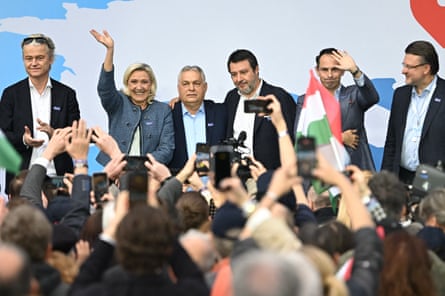
Orbán has inspired like-minded EU-obstructive leaders such as Slovakia’s Robert Fico and the Czech Republic’s Andrej Babiš, and boosted nationalist challengers such as France’s Marine Le Pen and the Netherlands’ Geert Wilders.
In short, this month’s election will have consequences far beyond Hungary, a country that accounts for just 1.1% of the EU’s GDP and 2% of its population but has, under Orbán, come to play a role on the international stage out of all proportion to its size.
Who are the key players and what are their platforms?
Orbán, 62, has been endorsed by Donald Trump, Italy’s Giorgia Meloni, and Alice Weidel of Alternative für Deutschland.
He was an anti-communist youth leader during the cold war and – with funding from his subsequent arch-enemy, the philanthropist George Soros – briefly researched “the concept of civil society in European political thought” at Oxford.
His Fidesz party’s 2010 supermajority enabled him to rewrite Hungary’s constitution and pass laws consolidating executive power, curbing NGOs and media freedoms, and severely weakening judicial independence.
This year, Orbán has run a classic populist campaign. He has sought to frame the vote as a choice between war or peace, telling voters they can preserve Hungary as “an island of security and tranquility” by electing him, or drag it into chaos and war by choosing Magyar, whom he paints as an agent of Brussels and Kyiv.
Polls suggest voters are more concerned with domestic issues such as healthcare and the economy, which has stagnated for the past three years. Food prices have risen to near the EU average while Hungarian wages are the third lowest in the bloc.
Magyar, 45, formerly a Fidesz disciple and loyal member of Orbán’s inner circle, burst into the limelight two years ago after his ex-wife, Judit Varga, resigned as Orbán’s justice minister when it emerged that Hungary’s conservative president, Katalin Novák, a key ally of the prime minister, had pardoned a man convicted in a sexual abuse case.
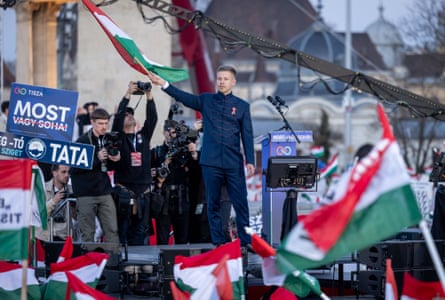
Magyar, a former diplomat who trained as a lawyer, distanced himself from Fidesz, accusing it of corruption and propaganda, and launched his Tisza (Respect and Freedom) party. It won 30% of the vote in the June 2024 European elections in Hungary, finishing second to Fidesz.
Magyar has pledged to return Hungary to a pro-EU orientation, end its dependence on Russian energy, restore an independent public media and judiciary, boost the economy, halt huge Orbán-era corruption, sanitise public procurement and unlock frozen EU funds.
How does the election work and who is likely to win?
Since 2010, Orbán has made hundreds of changes to electoral rules, including nearly halving the number of parliamentary seats to 199 and creating 106 unevenly sized single-member constituencies (the remaining MPs are elected proportionally using party lists).
The result is a Fidesz-friendly system, with far fewer votes needed to win in pro-Fidesz districts. Orbàn has also made it easier for the mostly pro-Fidesz Hungarians living in nearby countries to vote, and handed policy sweeteners to mostly loyal voter groups such as pensioners.
This means Tisza, which has an 8-12 percentage point lead among decided voters in most polls (although pro-government pollsters put the ruling party ahead), may need a six-point win over Fidesz to secure a majority.
Polling averages put the opposition party on 50% of the national vote and Fidesz on 39%. However, up to 25% of respondents are undecided, and experts warn that national polling does not reflect the complexities of Hungary’s gerrymandered constituencies.
Fidesz is more popular among retirement-age voters, polls suggest, leading Tisza by 50% to 20% in some polls, while Tisza is strongly ahead among under-40s and urban voters. Turnout could reach record heights of more than 80%, pollsters say.
What could happen?
Broadly, observers see three possible outcomes: a Magyar majority that Orbàn accepts; a Magyar majority that Orbàn does not accept; or an Orbàn majority. All would come with consequences.
For the reasons outlined above, Hungary’s elections can be categorised as free but not fair, and the chances of an Orbàn victory cannot be excluded. If he wins, he would almost certainly double down, conflict with the EU would intensify and domestic authoritarianism would increase.
If Orbán loses, especially by a narrow margin, he could contest the result. That would place the EU in an entirely unprecedented position and, despite likely opposition from Orbán allies, could eventually lead to the suspension of Budapest’s voting rights.
A Magyar victory acknowledged by Orbán would certainly ease EU-Hungary relations, although the opposition leader is hardly a progressive, and Hungarian policy on hot-button issues such as immigration is unlikely to change much.
Domestically, moreover, unless Tisza wins a supermajority (133 seats), it is unclear how much a Tisza-led government would be able to do: Orbán has ensured many laws need a supermajority to be changed and has stuffed all major state institutions with loyalists.