 3 hours ago
10
3 hours ago
10
Mastodon are near the end of a tour where they’re playing 22 shows in 14 different European countries during a record-breaking heatwave, when they video-call me outside a Bordeaux venue. Bassist and co-lead singer Troy Sanders says the experience has been “31 days of musical bliss”. He’s not being sarcastic, either.
“Things are super energetic, even at day 31,” he insists. “We’re contemplating even staying in Europe for a few days when this tour is over, because we’re enjoying ourselves so much.” It’s pleasantly surprising to see Sanders and drummer/co-vocalist Brann Dailor, sat to his left, in such high spirits, given the anguish and unrest they’ve endured over the last 18 months.
In February 2025, Dailor’s mother, Michele Lawrence, died aged 69. The next month, the band announced they’d parted ways with co-founding guitarist/singer Brent Hinds, ending a 25-year-long partnership. Hinds railed against his ex-bandmates on social media, calling them a “shit band with horrible humans … incapable of singing in key”, among plenty of other insults. He then died in a motorcycle accident, at the age of 51.
Mastodon are one of US metal’s most imaginative and successful acts, with a Grammy win and three Top 10 albums, and Hinds, a hard-partying maverick, had been a big part of what made them so distinctive and respected. Where contemporaries such as Trivium and Killswitch Engage were thoroughbred metal acts, Hinds gave Mastodon a defiant country twang, reflecting his Alabama upbringing and early years playing the banjo. Combined with Dailor’s virtuoso style, inspired by vintage prog, and co-guitarist Bill Kelliher’s primal riffs, “what we had sounded original and different,” Dailor says. “We always saw ourselves rooted in metal, but we could shape shift if we wanted.” When Black Sabbath played their farewell gig last year – two weeks before the death of Ozzy Osbourne – it was Mastodon who were selected to open the show, a band capable of igniting a stadium as well as inspiring reverence from the genre’s greats.
The deaths of Hinds and Dailor’s mother are the thematic core of the Atlantans’ upcoming ninth studio album, Marrow Deep. Its title references the fact that Dailor’s relationships with them were “the deepest you can get with a person. It’s hard to think of closer people that we could lose.”
The lyric-writing was the members’ way of processing those losses. Lead single Your Ghost Again dissects their complex relationship with Hinds, whereas Out Like a Lamb is for Lawrence, who died in her sleep after suffering cancer, rheumatoid arthritis and other ailments during her life. Dailor likens both Hinds and Lawrence to Keith Richards: figures who lived far longer than people assumed they would.
Hinds was arguably the most chaotic character in 21st-century metal. A former heroin addict, he lived in vans, boat sheds and abandoned apartments before joining Mastodon. He continued to party and drink long after his bandmates grew beyond such things – including co-guitarist Bill Kelliher, who almost died of alcohol-induced pancreatitis in 2009. “If any of us did half the stuff that Brent pulled off, we’d all have been dead years ago,” Dailor says. “We’ve always been a hard-partying band, but for the last 10, 15 years, the three of us really settled down and were focusing more on our live show and being productive in the studio. He was still rocking, which was, for a lot of people from the outside looking in, the most admirable thing about him. But from the inside it’s not always that much fun.”

In 2011, the drummer told Kerrang!: “People think [Hinds is] a fucking mental case, but there’s a beautiful person in there.” What was beautiful about him? Sanders answers: “He could find beauty in a lot of things: trees, mountains, caverns, oceans, music, people, handmade crafts. An appreciation for lots of originality and creativity.”
Dailor says Hinds loved “the honest things. He was the real deal, you know? His emotions were right there all the time and he could easily access them through his instrument.”
Following their breakthrough with 2004 single Blood and Thunder, the press touted Mastodon and their intellectual approach for “saving” metal. From 2007 to 2008, they supported Metallica on their stadium-filling World Magnetic tour. Their next album, 2009’s disorientatingly psychedelic Crack the Skye, was widely lauded; Hinds masterminded much of it, after being knocked out in a 2007 brawl outside an awards show and put into a three-day coma.
“He had vertigo for months and couldn’t really get up, so he was just sitting at home with an acoustic guitar,” Dailor recalls. “There were no bars for him to go to. He was forced to stay at home, so I think that, as a result, you have Crack the Skye.”
It started a string of successful records where the band wrestled with personal crises. The Hunter, a Top 10 hit in 2011, controversially stripped back Mastodon’s more brutal and progressive edges, was named after Hinds’s brother Brad, who died on a hunting trip in 2010. Dailor’s contributions to 2014’s Once More ’Round the Sun were inspired by his mother, who’d fallen off a chair in her kitchen and briefly been declared dead, and 2017’s Emperor of Sand was about cancer: Dailor’s mother and Sanders’ wife had been diagnosed with the disease, and Kelliher had recently lost his mother to a brain tumour. The album’s opener, Sultan’s Curse, won the 2018 Grammy for best metal performance.
“It summarised the story of us four dudes,” Sanders reflects. “Starting because we all appreciated Iron Maiden, Thin Lizzy and Neurosis, and then, 18 years later, we’re on this stage winning this award that was the furthest thing from our minds ever.”
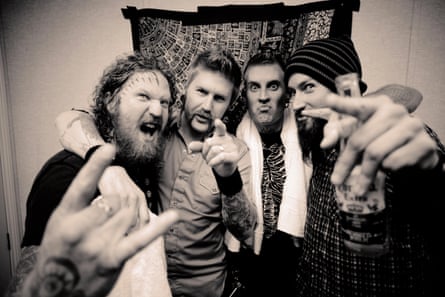
Despite the increased success, Hinds’s involvement dwindled. According to Dailor, the guitarist grieved for his brother through “alcohol, drug abuse and self-medication”. From The Hunter onwards, the drummer tried to make the rehearsal room “fun” to tempt Hinds to contribute, inadvertently leading to their change in sound: “Come down and we’ll have some fun! We’ll write Curl of the Burl and Stargasm and it’ll be fun! It doesn’t have to be heavy!”
In 2015, Hinds made headlines when he told Guitar Player, “I fucking hate heavy metal, and I don’t want to be in a heavy metal band.”
“Brent said a lot of things that he probably didn’t mean,” Dailor counters when I bring up the quote. “He liked to talk some shit and stir the pot and get people’s blood boiling, I guess. I feel like he felt he could control a situation if he threw a wrench.”
The way that the band and Hinds parted ways remains a mystery. In their statement, Mastodon said it was a mutual decision; Hinds later claimed he was kicked out for “embarrassing them for being who I am”. Dailor and Sanders refuse to tell me what happened, but Dailor shoots down the rumour that Hinds punched him in the face, which stems from a public appearance he made just before the announcement where he had a black eye. “Brent texted me when that was all stirred up, and he was like, ‘Dude, I can’t believe people think I punched you in the face!’” he smiles.
So you were still in contact after everything happened?
“He reached out late at night sometimes, like, ‘Hey, I still love you, buddy.’ I was like, ‘Yeah, my mom just died, I don’t know. I love you too, but I need time in my life. I can’t even deal with Mastodon stuff right now.’ It was hard for me to get out of bed, to be honest with you.”
At the same time, Hinds was bitter towards his former bandmates on Instagram, where he left the “shit band with horrible humans” comment. Sanders reacts sternly when I mention it: “He was trying to be funny. It was pretty cute.”
Hinds later made more comments, in excruciating detail: “I’ve never seen anyone in my life look in the mirror more than Troy Sanders. He thinks he’s God’s gift to anything. I’ve never met three people that were so full of themselves. It’s disgusting.” But Dailor says that the drama became nothing but a “blip” after the guitarist’s death. The remaining members received the news over the phone from Hinds’s ex-wife while they were at Atlanta airport. “I was devastated,” Dailor remembers. “All the shit-talking that had happened – you reference the Instagram comment section shit – I didn’t think about any of that. We got 25 years of a deep relationship with this guy. I could tell who he was by the smell of his farts.”
Marrow Deep is dedicated to Lawrence and Hinds, but it’s a celebration of the present and future, as well. It marks the debut of new guitarist Nick Johnston and the first album where former session keyboardist João Nogueira is a full-time member, and it contains their most technical and metallic music since the 2000s. There are also a host of guest spots from peers and influences, including Gojira’s Joe Duplantier, Lamb of God’s Randy Blythe, Queens of the Stone Age’s Josh Homme and Black Sabbath bassist Geezer Butler.
“We listened to Geezer’s book and he name-checked us at the end, as far as being a band that he was into,” Dailor says. “Sabbath have been very kind to us over the years. The first time I ever met Tony Iommi, he came into the dressing room and he was like, ‘Oh, Mastodon! Me and Geez were listening to you guys on the bus last night.’”
At the start of second track Poisonous Weapons, there’s a sample from 1986 cult thriller film River’s Edge, where Dennis Hopper’s character Feck yells, “And I felt so fucking alive!” That’s because – for Dailor, who’s sporting a River’s Edge T-shirt – “the band Mastodon feels fucking alive”.
“When one of the integral members, one of your brothers, dies, it’s obviously a very painful thing to go through, but it also makes you question where you’re at,” he explains. “Seeing Brent in his casket was so difficult to wrap our heads around, and it makes you want to feel fucking alive. We’re still here, so we better get to it.”