
 6 hours ago
9
6 hours ago
9
Robberies at European museums are becoming increasingly violent, with thieves sometimes brandishing guns, assaulting staff and using sledgehammers, axes and even explosives to smash their way into buildings and display cases, according to a report by Europol.
The EU police agency said that while museum thefts were generally seen as a non-violent form of organised property crime, member states had detected a recent shift “towards violent and forceful methods” that could point to the involvement of new criminal networks focused on specific cultural artefacts.
The report says: “Unlike typical cultural goods traffickers, who usually avoid violence and specialise in organised property crime or the theft of cultural goods, these individuals often have histories of involvement in other types of crime.
“Additionally, some thieves apprehended in recent cases appear to coordinate their efforts on an ad hoc basis, often recruited locally through social media and instant communication channels, without prior connections to each other. This differs from the usual structure of criminal networks involved in cultural goods trafficking, which typically operate in a core group organised around a leader.”
The report, published on Monday, found that precious metals and jewellery were the preferred targets because of their increasing value and the ease with which gold and silver could be melted down and jewels removed from their settings.
“Similarly, ancient Chinese porcelain artefacts are likely targeted by cultural goods traffickers for financial gain,” it says. “Driven by high demand, they are likely to be easily sold on the art market.”
Europol said a number of recent heists showed some thieves had few qualms when it came to using explosives or employing violence. In January 2025, a gang blasted its way into the Drents Museum in the Netherlands and stole several Dacian artefacts, many of which were subsequently recovered.
The report adds: “In some cases, offenders use firearms to intimidate security personnel and visitors. Some museum thefts have involved direct physical assaults on staff such as tying them up or using brute force against them. Across reported cases, the use of force is closely linked to targeted operations, suggesting prior identification of specific objects and preplanned execution.”
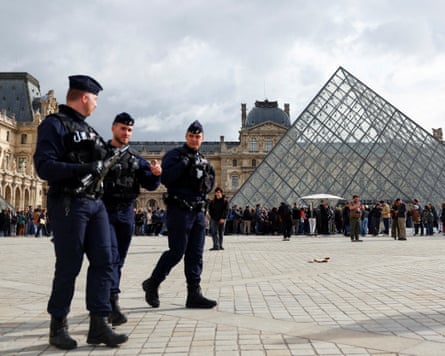
It pointed out that four hooded suspects equipped with baseball bats and axes had stolen seven gold and diamond-adorned objects from the Cognacq-Jay art museum in Paris in 2024, while the heist at the Louvre in October 2025 had involved similar violence.
after newsletter promotion
“To access the targeted artefacts, the [Louvre] thieves broke a window and threatened guards and visitors,” the report says. “They smashed the display cases in the Apollo Gallery, and stole jewellery worth an estimated €88m.”
Europol said that while more evidence needed to be gathered, it was possible low-level museum thieves were being randomly recruited “on a crime-as-a-service basis”.
It added: “Alternatively, some criminal actors and networks, typically active in other criminal markets, [have] realised the low-risk, high-profit potential of museum heists.”