 3 hours ago
13
3 hours ago
13
The controversial designer John Galliano is to get an unvarnished retrospective at the Metropolitan Museum of Art’s Costume Institute in New York next May.
Galliano, who is widely considered to be one of the most influential designers of the past four decades, was exiled from the industry in 2011 after he was filmed making a series of racist and antisemitic comments. He was fired from his position as creative director of Dior, a post he had held for 15 years, condemned by the media and later convicted and fined by a French court.
At the time it was questioned whether the British designer would ever be able to redeem himself in the fashion industry.
The decision by the Met to spotlight Galliano with his own fashion blockbuster, which will be only the third time it has given a living designer a solo exhibition, suggests that perhaps, he has reached the pinnacle of his atonement. The exhibition will be kicked off by the annual Met Gala red carpet extravaganza, making it one of the biggest events on the fashion calendar.
“The fashion business has a short memory,” said Dana Thomas, the author of Gods and Kings: The Rise and Fall of Alexander McQueen and John Galliano. “It is also remarkably forgiving of bad behaviours.”
Olya Kuryshchuk, the founder and editor in chief of the platform 1 Granary, described it as “refreshing” to see the celebration of a living artist rather than a typical thematic exhibition.
“Few designers have left a mark on fashion as profound as John Galliano,” she said. “He fundamentally changed the way fashion communicates emotion, fantasy and storytelling and influenced generations of designers.”
Thomas describes Galliano as having “worked hard to earn the industry’s forgiveness”. A documentary in 2024 by Kevin Macdonald delved into this redemption as the designer recalled how he spent time in rehabilitation for alcohol addiction and met with prominent Jewish leaders to seek forgiveness. Within three years of his outburst, Galliano was appointed the creative director of Maison Margiela, a post he held for a decade and where he was widely lauded.
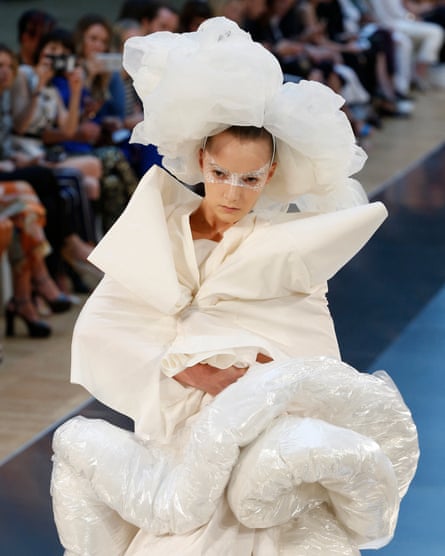
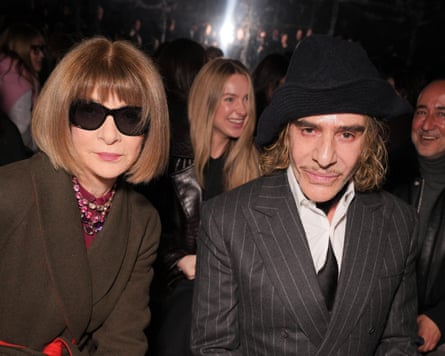
Since then his reintegration into the fashion industry has stepped up even further. In January, he sat front row at Jonathan Anderson’s debut show for Dior. In March, it was announced Galliano was embarking on a “two-year creative partnership” with Zara on a series of collections, the first of which hits stores in September.
According to the New York Times, the Met has held several meetings with Jewish leaders over the past year to discuss the event. In May, the Costume Institute’s head curator, Andrew Bolton, Vogue’s global editorial director and Met trustee, Anna Wintour, along with Galliano, attended a closed-door meeting met with “a handful of the most influential rabbis and Jewish leaders in New York City”.
According to a press release, the exhibition, which is split into three parts, “will address the derogatory conduct that fundamentally altered his career and public reception. In doing so, the exhibition will consider how artistic achievement should be understood alongside ethical accountability.”
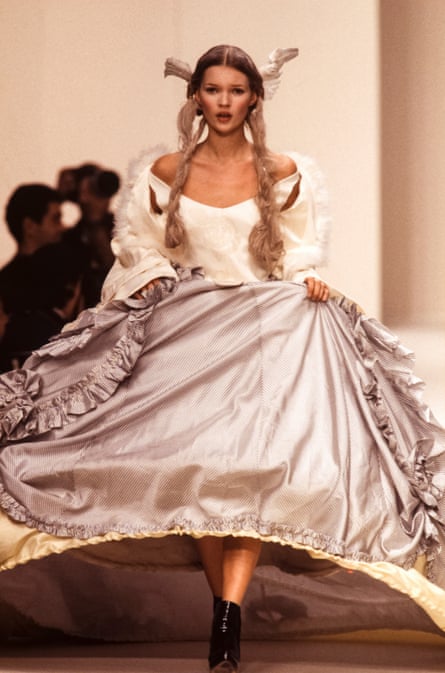
Wintour has championed Galliano since his graduate collection show at Central Saint Martins in London in 1984. She helped him secure financial support for his collections including his breakthrough spring-summer 1994 Paris show, which featured Kate Moss as a runaway bride, and championed him for roles at Givenchy and Dior. Insiders said a Met exhibition was originally planned for 2024 but was postponed after some board members voiced concerns.
Writing on Vogue.com Wintour said: “There is no one more deserving of an exhibition of this scale than John Galliano. He’s a great designer and his career isn’t defined by a moment – something that he will live with for the rest of his life. The exhibition won’t shy away from any of the darkness in John’s past. It’s part of what has shaped him. The show will take in the full arc of his career and grapple with all of it.”
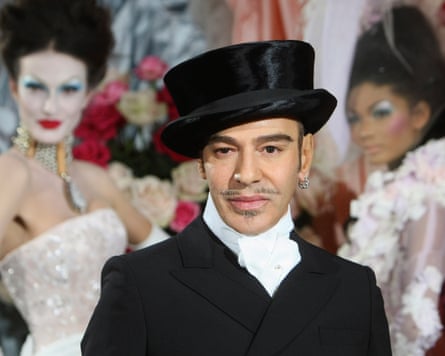
The exhibition John Galliano: Horizons will feature garments, accessories, sketches and research books with the aim of revealing “how Galliano brings places, histories, artistic traditions, narratives, and identities into unexpected relation and transforms these encounters into imaginative garments”.
As the Costume Institute is the holder of the largest collection of Galliano’s work in the world, the exhibition is expected to include pieces from his earliest collections alongside examples from his more recent tenures.
Bolton said the exhibition would tracer “how images become ideas, ideas become material, and material becomes emotion”. It would also explore “both how Galliano has remapped the world through fashion and how his conduct, its consequences, and changing cultural values have reshaped our understanding of his work”, Bolton added.
The show will begin by showing how Galliano’s collections relate to broader cultural events. The museum said this was where the exhibition would “directly address the rupture caused by his antisemitic, racist, and anti-Asian conduct in 2010 and 2011”.
However, rather than “presenting a conventional narrative of disgrace and redemption, the gallery will examine how memory, experience, cultural values, and historical circumstances continually reshape the reception of a designer’s work. It will invite visitors to consider how aesthetic achievement, ethical accountability, and institutional recognition intersect.”
Sarah Gresty, the course leader of BA fashion at Central Saint Martins, said Galliano was still an inspiration for many of its students. “Lots of students admire the skill and aesthetic ambition of Galliano so I am not surprised by the news. The museum obviously have decided his work merits that platform.”
Thomas added that the retrospective would show whether the public had forgiven Galliano too, or whether “extraordinary talent” ultimately outweighed even “extraordinary transgressions”.