 3 hours ago
13
3 hours ago
13
Animal rights campaigners are gearing up for protests and petitions aimed at persuading the French government to ban the hunting of Alpine marmots.
Open season on the rodents, members of the squirrel and groundhog family, begins in September, a few weeks before they go into a long winter hibernation.
Although the marmot is not a threatened species in France, its numbers are reportedly declining as a result of the climate emergency. Campaigners say they are opposed to them being hunted for fun.
Pauline di Nicolantonio, the president of the Association for Justice for Savoie Animals (AJAS), which has launched protests against marmot hunting for the last two years, said: “The question is a moral one.
“When you tell people that hunting marmots is allowed in France, they are shocked. The marmot is extremely popular and symbolic in the Savoie where we are based and elsewhere in the Alps. You only have to go into any tourist office to see it’s the main logo or emblem.”
Plant-eating marmots are spread across mountainous areas of Europe and North America. Most live in family groups organised by one dominant couple; when threatened they emit a high-pitched signal. In late summer and into autumn their bodies swell to up to 8kg as they stock up on food for a five- to six-month hibernation.
There are 15 marmot species in the world and as wild game they were traditionally hunted for their meat, fat and fur. Today, hunting is allowed in certain states in the US and Canada, and in France, Switzerland and Austria but banned in Italy and Germany. An average of 1,000 marmots are shot in France each year.
For generations of French children the marmot has been celebrated as the subject of folk tales and poems – one by Goethe set to music by Beethoven – the mascot of Alpine ski resorts and the sympathetic star of a popular television advert for a well-known brand of milk chocolate.
In fact, the rodents’ cuddly reputation belies a bloodier reality; much of its waking life is spent in a vicious battle for dominance and territory that often involves killing its parents or children.
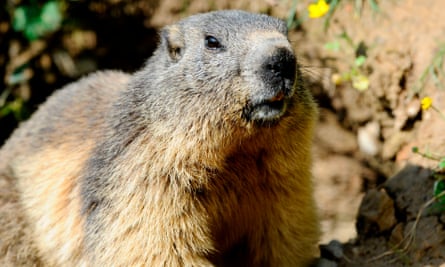
Christophe Bonenfant, a scientist at France’s National Centre for Scientific Research (CRNS) at the University of Lyon, studies marmots in the Grande Sassière alpine nature reserve. Evidence of the climate crisis in Europe is most evident in the Alps where rock faces are fissuring and glaciers shrinking at an unprecedented rate.
Bonenfant and his colleague Rébecca Garcia have noticed the marmots’ domestic and territorial battles becoming increasingly brutal as the climate emergency destroys the animal’s “social stability”.
They have also noted that while the animals are not listed as endangered, females are producing fewer marmot pups and a combination of the cycle of violence and smaller litters is leading to a steady drop in populations.
“What we are seeing is the breaking up of social groups, which are lasting less long, and more rapid changes of dominant animals in those groups,” Bonenfant said.
after newsletter promotion
“As a herbivore the marmot is quite low down the food chain but its importance is as food for carnivores like eagles and foxes and from time to time badgers. It also makes galleried tunnels that contribute to the aeration of the soil. It’s not classified as a nuisance species.”
He said of hunting: “It’s not a species that raises questions about conservation, so the root of the question is the morality of hunting animals, not just in France but everywhere, and why people enjoy killing animals for fun.”
There are strict hunting regulations set by individual local authorities limiting the number of marmots that can be killed and the season dates, but AJAS wants a national ban similar to that introduced in Italy in 1992.
French farmers claim the animals are a nuisance making holes in their fields causing damage to machinery. The National Hunters Federation says hunting marmots is “strictly supervised and regulated” and the open season lasts at most a month. “There is no justification for banning marmot hunting: the species is not threatened, there are no plans to classify it as a protected species and their numbers are on the rise.”
Di Nicolantonio said: “We know they are affected by the climate crisis and the data is worrying. Hunters often commission scientific reports to say there are lots of marmots around to justify killing them.
“Hunting them is cruel, absurd and unpopular but isn’t banned because it’s considered a tradition. In the past, we might have eaten marmots but now shooting them is simply recreational.”