4 hours ago
14
4 hours ago
14
The British ambassador to Bahrain has been accused of breaching government rules over accepting an award by the Gulf state’s king, a move critics suggest signals diplomats and civil servants are “up for grabs”.
This week, the ambassador, Alastair Long, received the Order of Bahrain from King Hamad bin Isa al-Khalifa, in recognition of his diplomatic tenure, which human rights activists and politicians say is in “direct breach” of the Foreign Office’s rules on accepting foreign awards.
Under the Foreign, Commonwealth and Development Office’s policy, heads of UK missions must not accept foreign awards during, on or after leaving posts. Foreign governments must also request permission to grant awards to UK nationals, which a source told the Guardian the Bahraini government had not done.
The award is understood to be the fourth to be given to British ambassadors to the Gulf state, following similar presentations to Long’s predecessors: Iain Lindsay, Simon Martin and Roderick Drummond.
In a letter to the foreign secretary this week, Lord Scriven said it demonstrated “a recurring pattern wherein the Bahraini government deliberately disregards” British diplomatic protocol.
“This sends a clear message: our diplomats and civil servants are up for grabs,” the Liberal Democrat peer’s letter to Yvette Cooper said.
“This trend does raise a number of significant issues for the UK government, particularly in light of the worsening human rights position in Bahrain,” Scriven told the Guardian. “It’s quite clear that the foreign secretary and politicians are not in charge.”
The letter also raised concerns around Bahrain’s mass revocation of citizenship for Shia Muslims of Iranian heritage, the targeted arrests of activists and Shia clerics, and the torture and death of Sayed Mohamed Almosawi. The 32-year-old was forcibly disappeared in Bahrain in March, and is said to have died in custody and bore signs of torture, according to Human Rights Watch (HRW).
According to the most recent reports from HRW, the Bahraini government continues to suppress free speech and has arbitrarily detained prominent human rights defenders and political leaders. Last year the state granted amnesty to 630 prisoners.
“Britain cannot signal any complicity or endorsement through the acceptance of foreign medals,” the letter said.
Freedom of information requests by human rights activists and shared with the Guardian also appear to show emails within the Foreign Office, at the time Roderick Drummond was ambassador in 2023, advising that the same award should be declined, but if needed, politely accepted “to avoid embarrassment” and kept “as a keepsake”.
They also reveal that Bahrain had notified the British government of the award beforehand, but had not with Drummond’s predecessors.
“Who are British ambassadors and diplomats actually working for?” Scriven asked. “It’s now becoming unclear.”
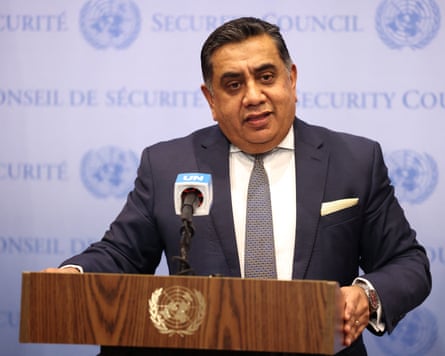
The peer and former UK Middle East minister Tariq Ahmad was accused of breaching transparency rules in 2025, after taking up a role as a paid adviser to a centre linked to Bahrain’s government. He was cleared by a UK civil service watchdog, the Advisory Committee on Business Appointments, to undertake the role, which was described by Scriven as “whitewashing”.
British campaigners have also accused Bahrain, alongside other Gulf states, of transnational repression on UK soil, including the targeting of political dissidents and exiled human rights defenders.
Sayed Ahmed Alwadaei, a prominent Bahraini human rights activist and advocacy director at the Bahrain Institute for Rights and Democracy, said the UK ambassador was “morally compromised” if he accepted the award.
“It was clear to us that Ambassador Long would be rewarded by Bahrain’s ruler after praising his ‘visionary leadership’ despite his brutal and dictatorial rule,” said Alwadaei, a torture survivor who fled persecution by the Bahraini authorities.
“No British diplomat should accept an honour from a ruler at a time when infants are being stripped of their citizenship and rendered stateless, and a 32-year-old man has been tortured to death,” said Alwadaei.
“The foreign secretary should take a stand against the dictator’s systematic disregard for British rules and diplomatic norms, if those rules are to mean anything,” he added.
The Foreign, Commonwealth and Development Office declined to comment on the record.