 7 hours ago
12
7 hours ago
12
In the dark before dawn, Juan Victor Hernández Campo was cheerleading a 5,000-strong crowd in the outskirts of the Cuban provincial capital of Pinar del Rio. “Aquí, quien no salte es yanqui!” he roared. “If you don’t jump, you’re a Yankee!”
Those in front of him, in T-shirts commemorating Fidel and Raúl Castro’s 1953 attack on the Moncada military barracks, roared back and – as much as their age allowed – leapt to their feet.
When Hernández asked them for more, one woman pointed out he would struggle for lift-off himself given the size of his belly. He responded by pulling his T-shirt tight and proudly rotating like a courting turkey. “¡Abajo el bloqueo!” He shouted. “Down with the blockade!” The crowd laughed and waved small Cuban flags.
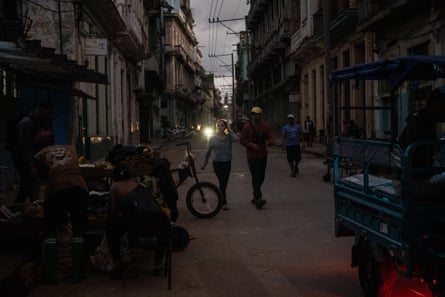
The rest of the island, 777 miles long and sweltering in the Caribbean night, was asleep. Houses beside the road on the way to Pinar’s Revolution Square appeared caught in one of the country’s endless blackouts.
For six months, Cuba has been suffering an oil blockade imposed by the United States, leaving an already parlous economy in tatters. The island’s national grid collapsed last Monday and on Sunday, and these outages followed three nationwide blackouts over nine days in July.
It can be a struggle to find anyone who doesn’t blame Cuba’s leaders for the situation, for landing the country in a position where its future looks set to be dictated by the most careless of US presidents.
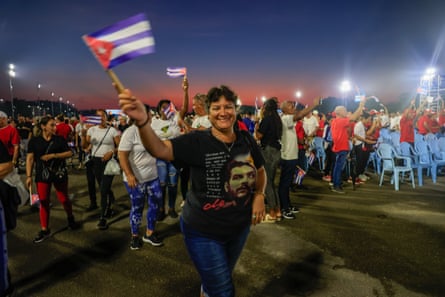
But in the Plaza de la Revolución, there was no shortage of communist party faithful. They had gathered before 3am to celebrate one of the Cuban regime’s most important anniversaries – the attack on Moncada is widely seen as the opening act for the revolution – waiting for the president, Miguel Díaz-Canel, and perhaps even the 95-year-old former president Raúl Castro, who hadn’t missed a 26 July celebration for 30 years.
“We’re here because we really feel it,” said Yomira, who works for a state agricultural business and agreed to use only her first name. “It’s the duty of any revolutionary Cuban to take part. We’re here for the homeland.”
Since the US attacked Venezuela on 3 January, abducting its president, Nicolás Maduro, Washington has made it clear it is pursuing regime change in Cuba.
With the US threatening such action, Cuba’s military has been readying itself for defence. The island has a small regular force of about 50,000 personnel but its equipment is woefully antiquated. So, instead of a conventional military defence, Cuba insists that in the case of invasion, the entire population – most of whom received military training when they graduated – will rise up in defence of the nation.
Few Cubans seem keen: there was amazement when 79-year-old Silvio Rodríguez – the country’s version of Bob Dylan – was shown on television receiving an AK47 from the president.
“The problem with a ‘war of all the people’ – the model they adopted from the Vietnamese – is that it’s almost entirely based on a reserve force,” said Hal Klepak, a professor emeritus at the Royal Military College of Canada. “And that reserve force has been atrophying since 1990 [when the Soviet Union withdrew its support].”
But Ebhony Semanat (a self-chosen pseudonym), says she would be ready to fight. The 50-year-old customer service manager received basic training when she was at university and then a few months ago she took two weapons training refresher courses after her union put out a call for volunteers.
“The idea of killing another person is so terrible that I don’t spend time thinking about it,” she said. “But if that moment ever comes, I’ll do whatever has to be done. What I’m not willing to do is live as a slave or return to the kind of slavery my ancestors endured.”
While Cuba’s population has traditionally split evenly between white and black – with every shade between – black people are more likely to point to the revolution’s achievements because of the racial inequalities it overturned in its early years. It is telling that more than 90% of Cuban Americans who fled the revolution in the 1960s identified as white.
“The revolutionary process deeply shaped my family and the life I have today,” said Semanat. “Although I’m a poor person I was able to attend university, I learned four languages. I was able to spend 15 years singing. I haven’t achieved great material things, mainly because I’ve never been an ambitious person.
“What I do is compare, very simply, is what my family was like before the triumph of the revolution with what they were able to achieve afterward,” she said, adding that the Cuban community in the US “are frustrated because the revolution took away privileges they had”.
Díaz-Canel arrived in the square exactly at 5.15am, the same hour the attack on the Moncada barracks had begun 73 years before.
He said that the celebration was being held in Pinar this year because, “amid power outages and shortages of every kind”, the city had “held its infant mortality rates to 4.8 per 1,000 live births and had a maternal mortality rate of zero. That is what we call heroism!”
Raúl Castro, who now lives under the threat of abduction having been charged with murder by the US in May, did not turn up. A 30-year tradition had been broken. “He asked me to convey a warm embrace to all,” said Díaz-Canel.
The sun had not yet risen when the president finished speaking and the crowd filtered away into the inky black.
Cuba’s negotiations with the US have so far been conducted by Raúl’s grandson, Raúl Guillermo Rodríguez Castro, better known as El Cangrejo (The Crab), a businessman with no official governmental position and a well-documented love of fancy restaurants and Hermès trainers.
Asked whether he felt such a negotiator was in the spirit of the revolution, Emilio Avila, one of the last to leave the square, said he didn’t know: “But I am sure the party will do the right thing.” As he walked away, two black military pickup trucks rolled past, anti-aircraft guns poking out of the back.