12 hours ago
10
12 hours ago
10
The indie-horror hit films Obsession and Backrooms opened this summer’s movie season with a bang, each grossing hundreds of millions of dollars and turning out legions of younger moviegoers. Many have pointed out the similarity between the films: both were made for comparatively minuscule budgets by gen Z directors – Curry Barker and Kane Parsons – who first rose to prominence on YouTube.
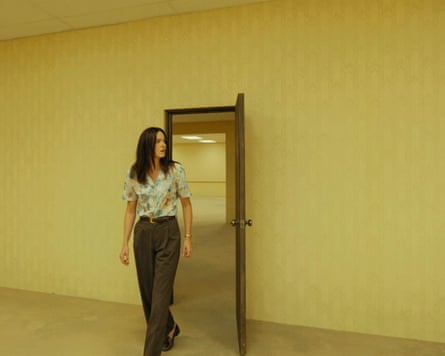
Fewer people are talking about the other quality the two movies share: a steady stream of analogue props and production design that plunges you into some bygone pre-digital era. Obsession’s lead characters Bear and Nikki work at a mom-and-pop music store, take rides in Bear’s vintage station wagon and the plot centers around a kitschy, old-fashioned gag gift. In Backrooms, Mary hawks her self-help cassette tapes on late-night infomercials, Clark smacks his TV to adjust the fuzzy signal – in the HDTV age, no one has done this for decades – and the wall-to-wall carpeted, ceiling-tiled backrooms look straight out of a long-abandoned office park on the side of the highway.
Jane Schoenbrun’s new film Teenage Sex and Death at Camp Miasma takes this trend to another level, following a young director Kris (Hannah Einbinder) trying to reboot an 80s slasher film franchise, who’d like to cast the original film’s starlet, Billy (Gillian Anderson) in the remake. Kris must go to the films’ now-deserted summer camp set to recruit Billy, whose star has since faded and now lives a reclusive existence there. The film blends the past and present into a funny and freaky, yet also emotional and cathartic, acid-trip of a movie.
But why exactly are all of these movies leaning into this vintage vibe? There’s no doubt that nostalgia has always had a powerful pull for film-makers and audiences alike. But there is also a functional reason: modern aesthetics lack the texture that horror movies need to thrive, texture that can be more easily found in past eras.
Think of the sleek, minimalist style that sums up post-2010s interior design: the vaguely Scandinavian surfaces and rounded edges that you might find at an Apple Store or a Blank Street Coffee. There’s nothing lurking around those squeaky-clean corners, and that’s a problem for a genre that relies on suspense. Horror film settings are basically haunted houses, after all – and haunted houses need those long shadows cast by that weird, old hatstand, the warped floorboards that creak and groan and that creepy old portrait that may or may not be watching as you tiptoe across the room. So many of our household items have been sucked up into the cloud: a grandfather clock, record player and stack of dusty tomes can now be replaced by one, compact smart home speaker on the countertop. It’s all gotten a bit too ordered and empty.
All three of these films feature their own spin on the haunted house. At the start of Obsession, Bear’s apartment is fairly ordinary, if a bit old-fashioned. But as Nikki begins to unravel, so too does the apartment, morphing into a grotesque sort-of nest for whatever Nikki is becoming – bodily fluids ooze into the carpet, windows and doors are haphazardly boarded up, casting the place in darkness; the only light emanates from the snowy picture on Bear’s bulky TV console.
The eponymous backrooms in Parsons’s film have mystery and monsters around every corner. Characters are constantly clambering over piles of broken furniture, sliding down chutes, and climbing up vertigo-inducing staircases. Meanwhile, things get even more meta in Camp Miasma, which largely takes place on the set of a horror film – a campground full of empty cabins and even a cinema. And within these haunted houses, there need to be ample objects for the characters to interact with: the rubber bats and bowls of cold spaghetti – err, I mean brains – that make us squirm.
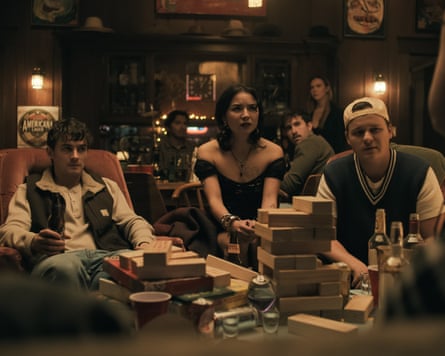
The One Wish Willow in Obsession looks like the type of gag gift I loved as a kid, like those little red fortune-telling fish or a Magic 8 Ball. Camp Miasma also literally opens with a montage of toys: trading cards, board games and other collectibles from the fictitious film franchise. Many of these objects have been digitized in recent years, however, which doesn’t always serve a horror movie’s best interests; it’s like watching a toddler play with a set of Lincoln Logs versus an iPad – one’s just more interesting to watch than the other.
Similarly, these films seem to be happiest with some electronic devices, just not our current iPhone era. It’s as if technology froze around the year 2000 – when station wagons roamed the streets, the Yellow Pages hung from pay phones, and of course, physical media were everywhere, with floppy disks and desktops, VHS tapes and VCRs, CDs, records, radios and more.
It’s worth remembering that these technologies weren’t always used for quaint or peculiar effect – they were once quite cutting edge. The Ring (a remake of the 1998 Japanese film Ringu) was powered brilliantly by a cursed videotape, creepy footage and an ominous telephone call with news of your impending death. None of this would work today – no one has a VCR, let alone a landline. A few years before, The Blair Witch Project’s fuzzy, jittery camcorder POV-style cinematography gave the film a frantic, unsettled feel – we never quite have the full picture of what is going on. And certainly less than if it was shot on the crystal-clear video we now have access to on our phone cameras. Backrooms opens with a very similar scene – the videographer is running from something, terrified, before it cuts out. What happened to the videographer? We don’t know. But if we keep watching, we might find out.
When a film sprinkles in these little totems from another time, it also creates a powerful feeling of surrealism. “I was a fifth grader hanging around in the horror section at the local video store, obsessively renting and watching and just dreaming,” Schoenbrun said in an interview about their inspiration for Camp Miasma. Horror plays with a dream-like state more than other genres, since they often feature supernatural elements and ask the viewer to suspend disbelief.
But this also allows film-makers to explore other realities aspirationally, which may sound counterintuitive given the genre’s depravity. And just like Schoenbrun tries to recreate a feeling from their childhood, maybe a part of us all yearns for the past – and these physical souvenirs remind us of these simpler times. Even the concept of “yearning” has become a gen Z buzzword; longing for something – in this case for a world that Barker and Parsons can’t even remember.
-
Teenage Sex and Death at Camp Miasma is out on 7 August in the US and Australia, and 21 August in the UK