 1 month ago
40
1 month ago
40
WAKEFIELD
17 JANUARY 2026
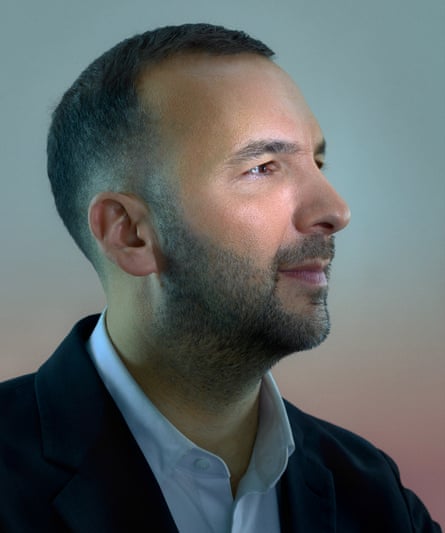
“I’m dying for a wee,” Zack Polanski says as he gets off the train at Wakefield Westgate. Why didn’t you go on the train, I ask? “It was very busy and too many people recognised me on the way to the toilet. I knew I’d never get there for all the conversations, so I came back.” When did it become hard for him to go to the toilet on a train? “2 September,” he says. “The day I was elected.”
At first, I wonder if Polanski is bigging himself up, but over the next couple of weeks I see for myself he is not exaggerating. While Polanski says it’s not, and cannot be, about one individual, in Green circles there is much talk of the Polanski effect. Since he was elected in September 2025, the Greens have risen by an average of four points in the polls. Just before going to press, the Guardian’s latest poll tracker had the party at 13.5%, only five points behind Labour, on 18.6%; 20% of people who voted Labour in 2024 now say they will go Green.
It’s astonishing how life has changed for the party leader over five months. For 20-odd years Polanski, aged 43, was a jobbing actor nobody had heard of. He got by, just, by supplementing his acting gigs with all sorts of jobs – teaching drama, dressing up as hotdogs, handing out flyers at the nightclub Heaven, working in bars and, now notoriously, as a hypnotherapist.
Polanski became deputy leader of the Green party in 2022, and still pretty much nobody had heard of him. These days, he looks like an old-timer, born to a life in politics. But the truth couldn’t be more different.
We reach the hall in Wakefield where supporters are waiting to welcome Polanski. Kate Dodd, a local party co-ordinator, says when he came here two years ago, there was an audience of a dozen. “We booked the same venue and pushed the capacity to 50, but in October we thought we’d better get a bigger room. We’re expecting 400 and there’s a reserve list. It’s a bit overwhelming. I never thought this would happen, not here.”
Wakefield is not traditionally fertile territory for the Greens. But last May they sensed things might be changing. Polanski announced he was standing for the leadership, and local people were already disillusioned with the government, despite the town being a Labour stronghold. So Wakefield Greens held a strategy meeting. “We had about 80 members and set ourselves a target of 150.” It was ambitious, but Polanski wanted to rebrand the Greens as the party of hope, in opposition to Nigel Farage’s Reform, which he saw as the party of hate. “We now have nearly 600 members,” Dodd says. “That is how things have changed. Some of it is down to our activism, but a lot is down to Zack’s leadership.”
To say there’s a lot left to be done is an understatement. Of the 63 councillors on the council, not one is Green. How many seats would Dodd like to win in the May elections? “All of them, obviously.” She laughs, then gets serious. “Our goal is to win half a dozen.”
The Green party looks different from Britain’s other political parties. Many members here today are young. Dodd introduces Olli Watkins and Ash Howick, both wearing green HOPE badges; they were parliamentary candidates at the general election, aged 21 and 22, and have been partners for five years. Next to them is Incy Wood, an artist and wheelchair user in a magnificent rainbow-coloured checked suit and orange bob. You can’t move here for orange, blue and purple hair.
Few people I speak to mention the environment. It’s taken for granted they’re green. The word on everyone’s lips is socialist. “People had seen us as a party for climate justice but hadn’t realised the extent to which we are a socialist party,” says Dodd, a Labour refusenik.
Wood introduces Polanski to the audience. “I would like to welcome an absolute lunatic and general rattler of the establishment, Zack Polanksi.” There’s a roar.
“Nigel Farage called me an absolute lunatic,” Polanksi explains, then proceeds to talk fluently, at 100 miles an hour without notes, about community, the cost of living crisis, taxing the rich, making the world work for the majority. When he became leader, he said the Greens were reclaiming the language of Reform; they were the true populists because they represented regular civilians, not the elite. Today, we hear less about populism. It turns out it’s not such an easy word to reclaim.
In a tiny room, I join Polanski for a lunch of vegetable tacos. He is a vegan and supports Forest Green Rovers, the world’s only fully vegan football club. After he won the New York mayoral election, Zohran Mamdani, to whom Polanski is often compared, invited him for a tete-a-tete. Polanski declined because he doesn’t fly.
He seems like a caricature of a to-the-manure-born Green politician. But, he says, “I couldn’t have been less political for most of my life if I’d tried. I actively avoided conversations about politics.”
Polanski grew up in a traditional Jewish family in Manchester – a happy time until, when he was 11, his parents split up: “It felt like the world had broken.” He says he became a pawn in the hostilities. While his two older half-siblings stayed with their mother, he went to live with his father because he didn’t want him to be alone. Until his barmitzvah, at 13, he attended synagogue regularly, then suddenly stopped. Why? “Because it was a thing I did with my parents. And once we weren’t going together, it felt quite painful to go.”
By the age of nine, Polanski realised he was gay, though he couldn’t put it into words. “I was watching the wrestling and realised I wasn’t just interested in that; there was something about these men that I was really drawn to. I didn’t recognise it as gay till I was 14.”
But at school he was bullied after being caught snogging in a nightclub. “My first kiss was with a young Muslim man called Jihad when I was 14.” He knows he shouldn’t have been clubbing in his early teens, but says it was inevitable. This was the time of Section 28, which banned the “promotion” of homosexuality by local authorities. “I couldn’t talk about being gay at home and you weren’t allowed to at school.” He viewed Canal Street, the focal point of Manchester’s gay village, as his safe space. In reality, it was anything but. “It’s clearly not an appropriate place to go at that age, and I was definitely meeting age-inappropriate people.”
Polanski, who then went by his birth name David Paulden, had come out at school but not to his family. These years were traumatic: “I was homophobically bashed on Canal Street at 15, and ended up in hospital. Then I was kicked out of Stockport Grammar, where I was on a scholarship. I never felt I belonged there. I got kicked out for not making grades and being cheeky. One teacher said I’d never make anything of myself.”
BOLD POLITICS
11 DECEMBER 2025
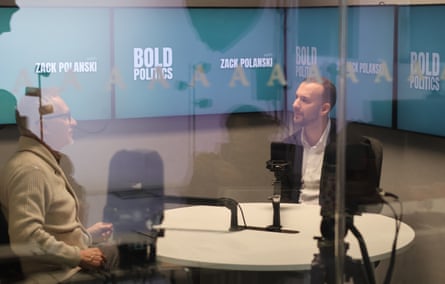
A month before our visit to Wakefield, I meet Polanski in London where he is recording his podcast Bold Politics. He invites people he admires on to the show and soaks up what they can teach him. It’s a clever format. As well as acknowledging how much he needs to learn, it means that influential leftwing thinkers such as the Guardian columnist George Monbiot, journalist Carole Cadwalladr and economist Grace Blakeley leave having had a positive experience, then spread the word.
But lots of people are less positive about Polanski. On social media he is trolled for anything from his stance on Nato (leave, because the US is an unreliable ally), his grasp of economics, his style of running, his teeth, for saying Israel has committed genocide in Palestine (despite a UN commission reaching the same conclusion). And it’s not just trolls who are critical. In early December he appeared on Rory Stewart and Alastair Campbell’s podcast The Rest Is Politics, and he is still licking his wounds. He appeared to confuse the country’s national debt and the deficit. When asked England’s top rate of income tax, he incorrectly said 40% rather than 45%. Stewart, a former Conservative MP, was brutal. “I was horrified beyond belief on the economics stuff. It’s not acceptable,” he told listeners once Polanski had gone. “If this is where British politics is going, no, no, no.”
Today’s guest on Polanski’s show is Gary Lineker, who owns the company that hosts The Rest Is Politics. Polanski is a skilled presenter. Again, he doesn’t use notes. The interview makes headlines, with the former Match of the Day presenter saying he’d never go into politics and admitting, “I cry most days when I see innocent kids being killed” in Gaza. But Polanski can’t leave his treatment on The Rest Is Politics alone. He repeatedly tells Lineker it was unfair – he insists they had promised not to go into granular detail and that he was misrepresented by Stewart, who told the audience he said he could learn numbers easily because he was an actor, suggesting he was acting out the role of politician. It obviously got to him. I wonder if this is him standing up to the establishment or being oversensitive.
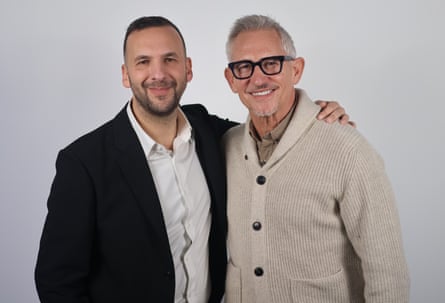
I ask Lineker later what he makes of Polanski. “I like a lot of what he says. He seems a really good guy: fresh energy and a bit of kindness.” Does he seem different from other politicians? “I think so. He seems more open. He’s not in power, so that makes it a little bit easier.”
What does he think about Stewart’s attack on Polanski and his reaction? “Well, if people are having a pop at you, you must be doing something right. You’re going to get caught out occasionally, and he’s only been in charge for a few months. To be a politician, if you’ve not got thick skin, you’re in the wrong job.” Is Polanski’s thick enough? “I don’t know. We’ll find out, won’t we?” Despite everything, Stewart goes on to name Polanski his politician of the year.
PALANTIR PROTEST, LONDON
22 JANUARY 2026
Polanski, a couple of dozen supporters, a few journalists and a smattering of police are outside Palantir’s British HQ in Soho. Palantir is a US software company that helps huge organisations make sense of their data. Using a loud hailer, Polanski says it is a surveillance company providing the software used by US government agencies such as the CIA and ICE. It also supplies the Israeli Defence Forces with technology for “war-related missions”. In 2023, it signed a £330m deal with the British government to unify data across the NHS, which
comes up for review soon. Polanski is here in his regulation black suit, open white shirt, Dr Martens and green raincoat to deliver a letter telling Palantir to “pack its bags and get the hell out of the NHS”. But there’s a problem: “They won’t let me deliver the letter.”
“Noooh!” the small crowd shouts. “Shame!”
“But we will be emailing it, so they will be getting it,” Polanski announces. Then he changes his mind, gets on all fours and tries to slip the letter under the front door.
“Palantir out of the NHS! Palantir out of the NHS!” the crowd chant. It doesn’t really work. Too many syllables.
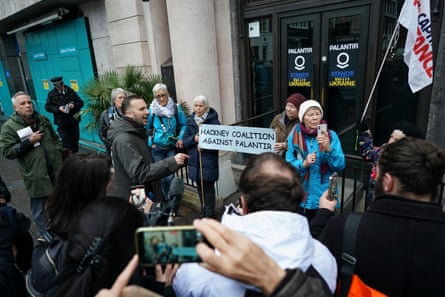
Mo, a youthful NHS consultant, is holding up a Green party banner. How long has he been a member? “Half a year.” Why did he join? “Straight up, Zack Polanski. He’s clear about what he believes in. He’s got very left-leaning views. I used to be a Labour party member. After Keir Starmer took over and it was clear he was taking the party in a particular direction, I left.”
On the corner of Soho Square, a delivery worker approaches two young police officers. “It’s him,” he says, pointing at Polanski. “He’s saying good things.”
“Is it really?” the female officer says. “Really?”
The male officer gets his phone out and searches for a picture of Polanski. “We didn’t realise it was him!” the female officer says. Does she like him? She laughs nervously. “I’d better not say.”
HACKNEY
LATER THAT DAY
It’s now afternoon, and I meet Polanksi in a cafe near where he lives, full of young parents and their children.
“Thank you for everything you’re doing, Zack,” one mum says, as if they’re resuming a chat. When we leave, I ask if he knows her. “No,” he says. “People often talk to me as if we’re in the middle of a conversation and we know each other. I believe the phrase for it is a parasocial relationship. It’s really lovely because it feels like wherever you go, there are friends you’ve not met yet.”
We make our way through a park and head for a pub. I ask if he thinks he’s at peak popularity – still untainted by power because he doesn’t really have any. “I hope not, but that’s a possibility.” The Green party has almost tripled its membership in a year to 190,000 (67,000 more than the Tories), putting them in third place behind Labour, whose membership has fallen to a reported 250,000, and Reform, whose website claims 270,000.
A man with long orange hair on an orange bike cycles up. “Hey, sorry to interrupt,” he says. “I know you’re local and I run a charity called the Tree Musketeers.’’
“My boyfriend has volunteered for you,” Polanski says. “You do things in Springfield Park, don’t you?”
“Yeah, and we’re planting trees there on the 31st if you just want to come and say hello.”
“I’m local, but sadly I’m rarely here. I imagine my boyfriend might be there.” Polanski asks his name. Marcello, he says. “Every time I look there are new trees. Thank you for everything you’re doing, Marcello!”
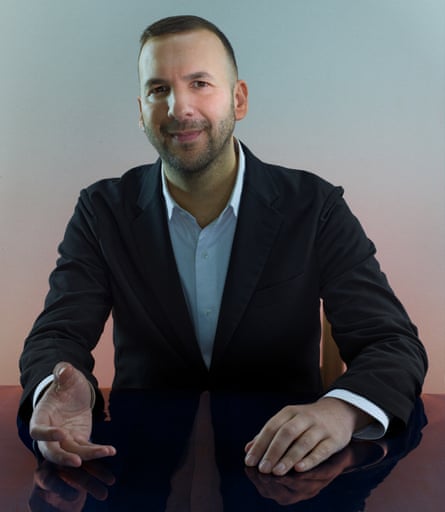
Over the decades, I’ve followed many politicians, but none has been greeted as positively by the public. It’s not surprising he has been compared to Mamdani. Both are leftwing, charismatic, have names beginning with Z and won elections against the odds. “I think it’s a huge compliment,” Polanski says. How are they alike? “Well, we’ve both come from the grassroots and have a positivity about politics and an unconditional solidarity to minority groups.” But while Mamdani dresses fabulously and is effortlessly urbane, Polanski is snaggle-toothed, a bit cheesy and at his happiest in pre-loved clothes. It’s part economics (he still struggles for money, and is hoping to work his way on to the property ladder with his boyfriend, Richie Bryan), part green ideology, part character. “The right wing are obsessed with my teeth,” he says. How many are missing? “Two.” He points to a gap. “Important story. The baby tooth fell out a couple of years ago. The adult tooth is waiting to come through. I’m worried when it does it will look like I’ve got an implant, so I have to make sure everyone knows I haven’t been bullied into filling that gap!”
He tells me about an important part of his life. At 18, he left home for Shrewsbury, where he worked for a children’s adventure company. For the first time, he was moving in a different world, with colleagues from other countries. It was around this time he changed his name. Though he had given up on synagogue, he was interested in Jewish history – how his ancestors had fled pogroms in Latvia and Poland, and had been called Polanski. But also: “I had a stepfather called David I got on badly with. I didn’t want to be a ‘little David’ version of this man making my life difficult.” He chose Zack because of the Jewish character Zach in Michelle Magorian’s wartime novel Goodnight Mister Tom. “Once I changed it, I found out it was probably Polinski. But by then I was, like, I’m not changing my name twice!”
It felt like a new start. He went on to Aberystwyth University in Wales, where studying drama was the making of him: “I became camper and more flamboyant. Extrovert.” Then he went to a drama school in Atlanta, Georgia, got hooked on American football and withdrew into his shell. “I desperately didn’t want people to know I was gay. There was a lot of toxic masculinity around. My obsession with American football was something to do with retreating a little bit from my sexuality.”
In the few weeks I’ve been following Polanski, more high-profile politicians have taken a pop at him. A couple of weeks ago Wes Streeting criticised Polanski after he said on Question Time he appreciated the work migrants did, particularly as so many were in the caring industries and he for one wouldn’t fancy wiping people’s bottoms. But Polanski says the attack was cynical, pointing out that Richie works in a hospice as a physiotherapist and has wiped his fair share of bottoms. “It was the most fucking ridiculous attack ever.” Polanski so rarely swears that it’s shocking when he does. “Hundreds of care workers told me they appreciated what I was saying. And if Wes Streeting really wanted to do something about care workers, he should pay them properly and treat them with dignity.”
Yesterday, he says, at prime minister’s questions, Starmer “went on a rant about me being high on drugs and soft on Putin. I’ve never taken a drug in my life. As for the Putin stuff, that just isn’t credible. Putin is an autocrat and dictator. It just feels like a desperate smear. So I said he was low in the polls and hard on the country.”
Not only has Polanski never taken drugs, he has never drunk alcohol. “It’s not for moralistic reasons. I’ve always had a lot of energy about me. People used to say, ‘I drink to be comfortable on the dancefloor’, but I always felt perfectly comfortable dancing without drink or drugs.”
In the pub, he orders tea with oat milk and chips. I ask if he felt frustrated all those years doing multiple jobs and working day and night. He looks at me as if I’m mad: “I was having the best time ever.” This was when he found his confidence. “The flyer-boy job was pivotal. You were handing out leaflets for, say, a £2 drink, and people rejected you over and over. So you have to build up the armour, keep up that positivity when people tell you to fuck off, and 10 seconds later you’re going again: ‘Hey, would you like to come to G.A.Y. tonight?’ That built a resilience, which helped me with acting, because you go to an audition and never hear from them again.”
He became so confident, he began giving drama students body confidence lessons – how to hold yourself, stand, breathe. And after doing a course in hypnotherapy, he combined the two. “Then, famously, I met a Sun journalist and got into a bit of trouble.” Ah, Boobgate.
In 2013 a Sun journalist asked if he could hypnotise her into having bigger breasts. “She said, ‘Are you willing to do it as an experiment?’ I said, ‘Yes, so long as you make it clear it’s not something I normally do, and it’s your idea.’ She then wrote this absurd article saying it worked, which should be the biggest clue the whole thing is nonsense. What’s important is I’m not just saying this retrospectively. I went out on radio the next day and said this article doesn’t represent me.”
I quote from the Sun: “This is an extremely new approach but I can see it becoming popular very quickly, because it’s so safe and a lot cheaper than a boob job.”
Did he actually say that? He looks sheepish. “Yeah, I said that, because once you’ve accepted you’re doing it as an experiment, you go along with the absurdity of it.” The piece said he charged £220 a session. He insists the Sun never paid him a penny, and he charged drama students whatever they could afford.
Did he feel humiliated? “No. I thought it was ludicrous and embarrassing, but not something to worry about because I was an actor doing all these quirky jobs.”
Was he a good actor? “I’d like to think so.” Was he in any movies or TV shows I might have seen? God no, he says, he was far too snobby for that: all that mattered to him was Shakespeare or community theatre. It was the latter that finally politicised him. He got involved in interactive theatre, where actors and audience mingle and shape the story. “In one show, Echo/Chamber, I was leader of an organisation, a bit like Extinction Rebellion, and there were 50 people in the audience and I’d bark orders at them, pushing them to a point where they would overthrow me and ideally kick me out, and the rest of the show would happen without a single actor. In The People’s Revolt at the Tower of London, the audience could decide why they were unhappy and what demands they would make of the government.”
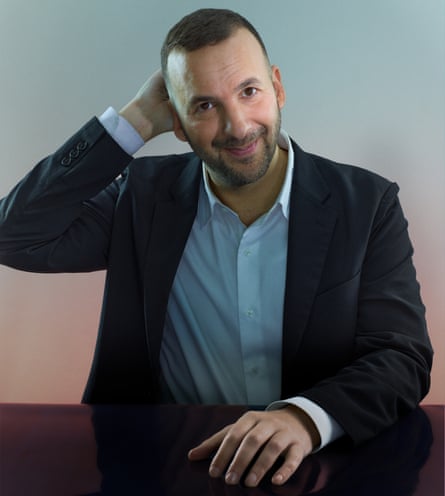
It was after this that he joined his first political party, the Lib Dems, in 2015, and stood as a councillor in north London in 2016. “We got obsessed with proportional representation,” he says now, “because almost every conversation turned to the fact that politics is broken, we need to change our voting system. And back then the only people talking about that were the Lib Dems.”
But during Brexit, he became disenchanted. “I don’t want to be rude to former friends, but suddenly I noticed the Lib Dems seemed quite stuffy and not really my vibe. The Green party felt right for me.” He joined in 2017, by 2021 had been elected to the London assembly – the first decently paid job in his life – and in 2022 he became deputy leader. Last year he decided to stand for the leadership. He thought the party should be more radical and inclusive, and offer a genuine counter to Reform. If Labour refused to tell a positive story about migration and redistribution, he told members, his Green party certainly should. He won 84% of the vote.
Time for our next round – I get a glass of red, he gets another pot of tea. Chips all round. The most seductive thing about Polanski as a politician is his willingness to say things the mainstream parties run scared of. Yes, he wants a wealth tax; yes, he wants to leave Nato and forge a new alliance with Europe; yes to a universal basic income. And, of course, these are also the policies that will scare off more conservative voters. If he realised, say, his stance on Nato could cost the Greens 20 seats in the next parliament, would he compromise? “No way! I would look at a different way to communicate it, to win the argument.” Would he really refuse to work with a Labour government? “I said I wouldn’t work with Keir Starmer.” And he’ll stick to that? “Yes, you need to be sincere and coherent. And this is a man who was complicit in a genocide, wanted to slash disability benefits … But my calculation is he won’t be around much longer, so it feels pretty irrelevant to talk about working with him.”
Polanski is hoping to win a seat at the next general election. He’d love to win one in London, which he has regarded as home for a long time. What about taking on Starmer in Holborn and St Pancras? “Well, that could clearly go Green,” he says with a mischievous smile.
G.A.Y. AT HEAVEN
25 JANUARY 2026
Polanski is doing a Green fundraiser at Heaven, the legendary LGBTQ+ nightclub in London’s West End. The dancefloor is heaving. Upstairs, Polanski is reminiscing with his former boss and Heaven owner Jeremy Joseph. The suit and DMs have gone. Tonight it’s jeans, a rainbow-coloured sweatshirt and trainers.
He tells me his day has been ruined by Labour announcing it won’t let Burnham stand in the Gorton and Denton byelection. Journalists have been calling Polanski all day asking if he’s tempted. (He’s not.)
Joseph says how much Heaven is struggling under Labour. “The rise in national insurance cost us an extra £8,000 a week. I don’t know if we’ll make it through the year. They say they’re doing it for the workers. Well, if there are no businesses, there are no jobs.”
What was Polanski like as an employee? He laughs. “Terrible barman!” And as a politician? “He’s amazing. He’s the only politician I’m willing to put on here at the moment. And this is a perfect place for him to get his voice heard. On a Saturday night we get 2,000 people.”
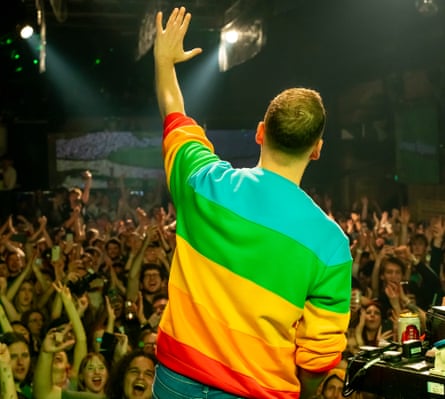
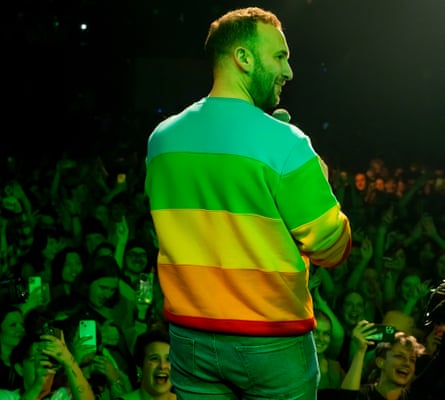
There are two things I need to check, I tell Polanski. Was he born in Salford or Manchester? “I grew up in Manchester, but I was born in Hope hospital, Salford. Here’s your headline: I came from a place called Hope.” He loves a bit of cheese.
Finally, I say, I’ve read you are bisexual. Is it true?
“Really? Where does it say that? No, definitely gay.”
Joseph grins. “It might have meant that when he couldn’t get it, he paid for it. Buy-sexual.”
Back on the dancefloor, the crowd chants Polanski’s name, fists pumping. “Are we ready to take on power and wealth?” he asks from the stage. “Are we ready to get our country back? Are we ready to make hope normal again? Then make some noise.” And they do.
The DJ starts a beat and Polanski is spitting on it hip-hop style. “They will try to divide and distract us. They will say the threat is on a small boat or a dinghy. But we know the real threat: it’s flying above our heads in private jets. Flying above our food banks. Flying above people who are homeless. Flying above the climate crisis. But we are so strong when we find our collectivity … Together, through community, that’s how we’ll change the world.”
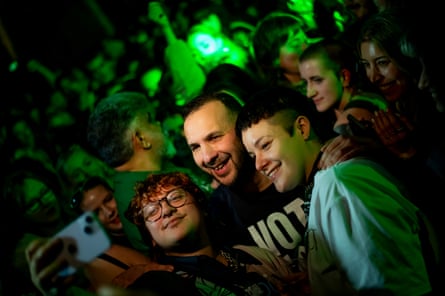
As Bonnie Tyler’s Holding Out for a Hero starts playing, Polanski rips off his sweatshirt to reveal a black T-shirt that reads “Vote Hope”. He dives into the crowd, and I leave him dancing with them.